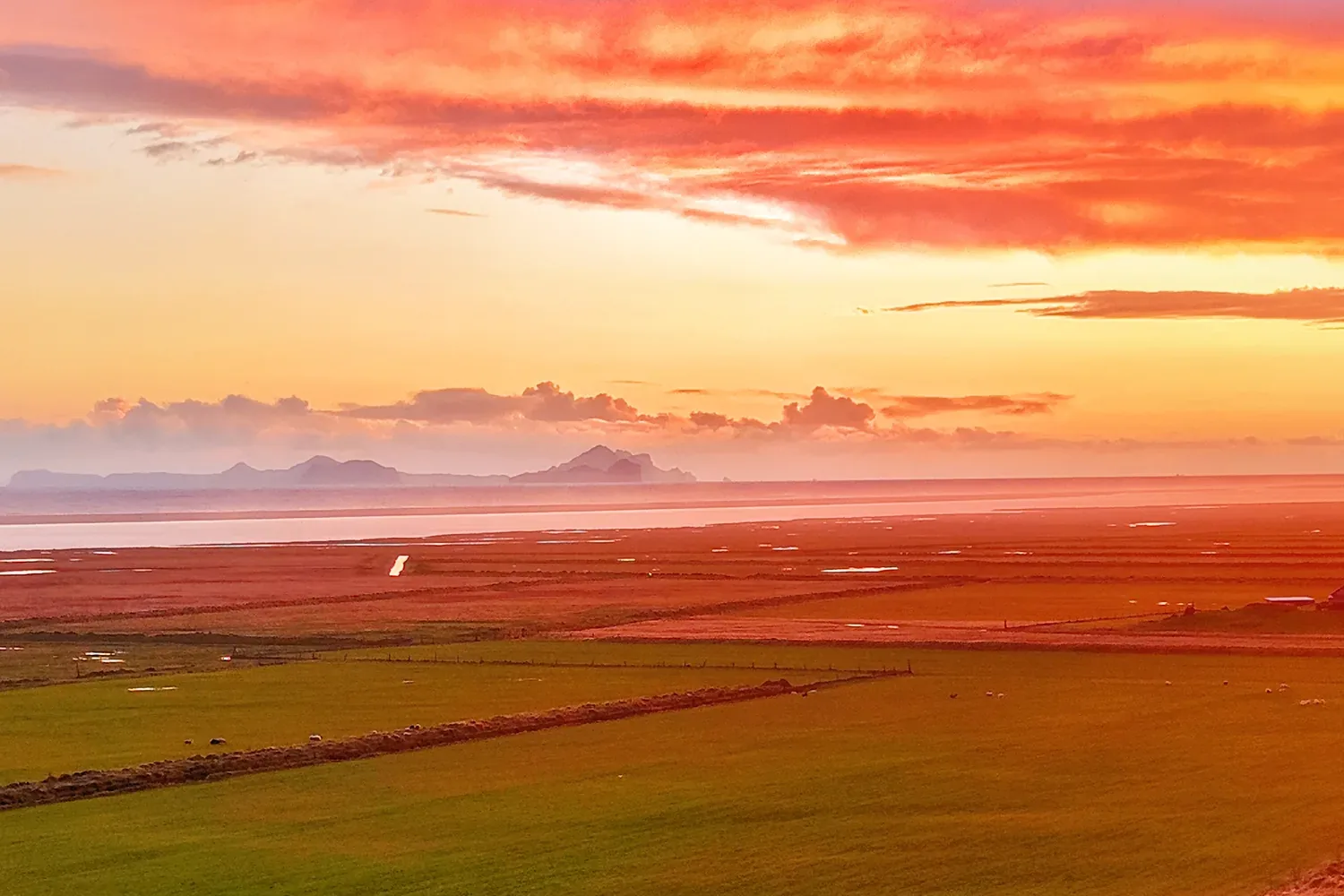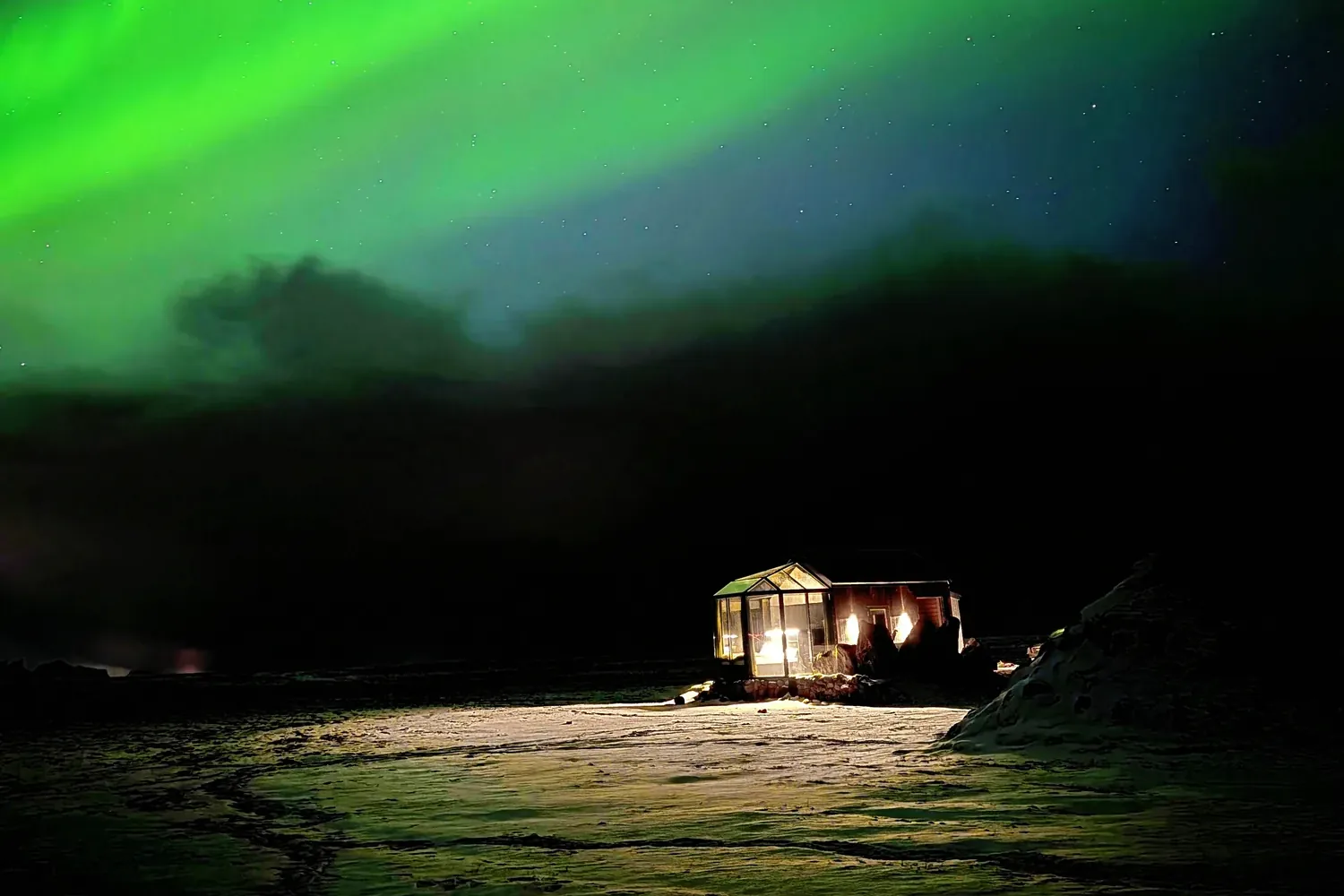
We live here. Not in a nearby town, not in Reykjavík with a shuttle out. Our house is on Ormskot, the farm where the cabins are, and our sheep and horses are outside the window. That means we have spent a lot of winter nights standing in a field at two in the morning in a coat over pyjamas, getting it wrong, and slowly getting it right.
This is what we have actually learned. Not a roundup. Not a listicle. Just the things we would tell a friend who arrived with a camera.
Why this particular patch of ground works
We are at the foot of Eyjafjallajökull, in the Eyjafjöll area, about ten minutes from both Seljalandsfoss and Skógafoss.
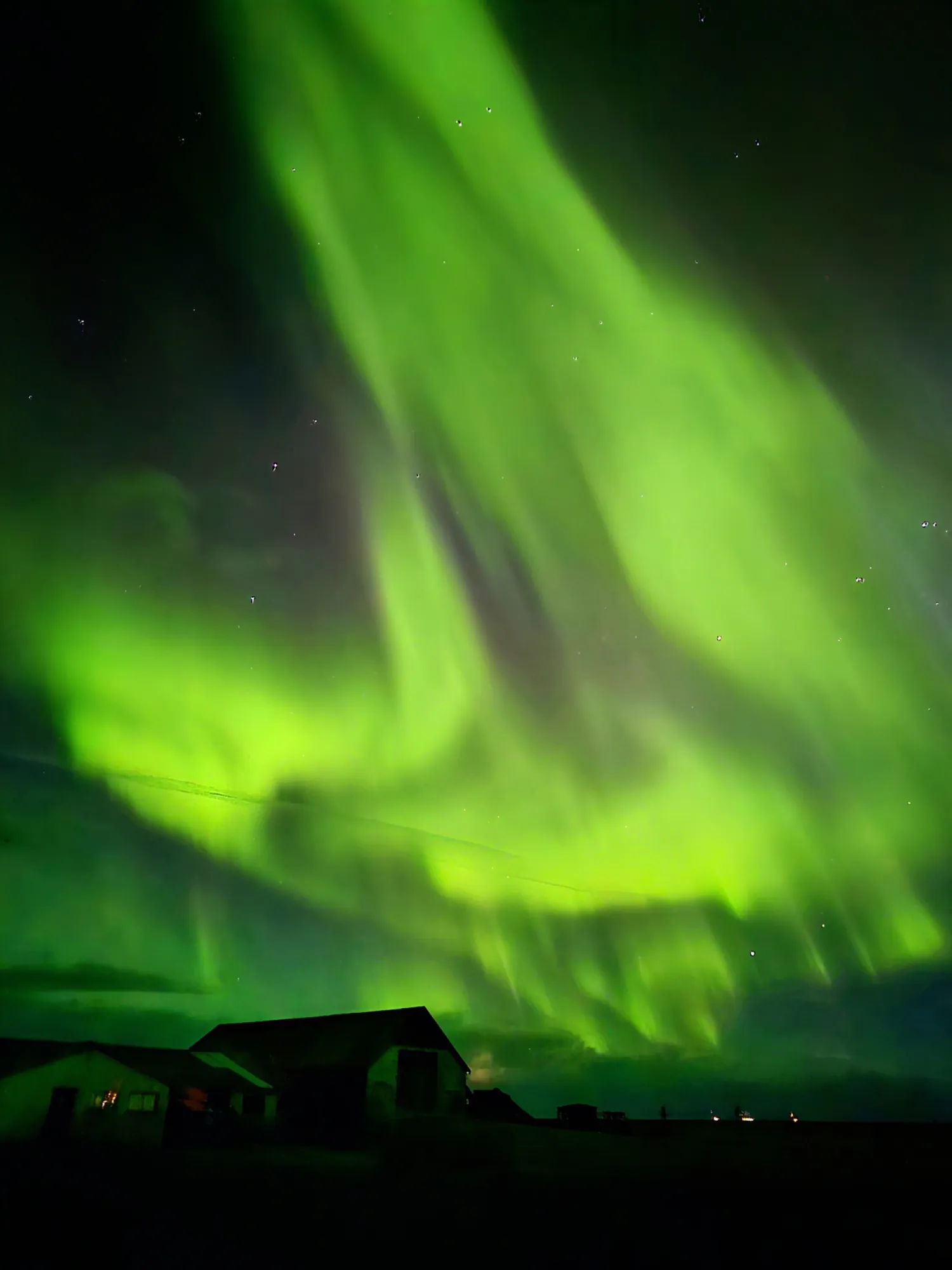
The thing that matters for photography is what we do not have: light. There is effectively zero light pollution here. No streetlights, no town glow on the horizon, no floodlit car park two fields over. When you switch off the cabin lights and let your eyes adjust for twenty minutes, the sky you see is the sky your sensor sees.
That is harder to find than people expect. A lot of accommodation marketed as “aurora” sits close enough to a village that there is a permanent orange smudge along one edge of every frame.
What a glass roof actually does — and what it doesn’t
Two of our four cabins, Aurora Glass Cabin I and II, have glass roofs. You can lie in bed and watch the sky. It is the reason most people book them.
For photography, be realistic about what that means.
It lets you wait
This is the real advantage, and it is bigger than it sounds. Aurora photography is mostly waiting. Standing outside at minus eight for three hours waiting for a substorm that may not come is how most people give up before the good part.
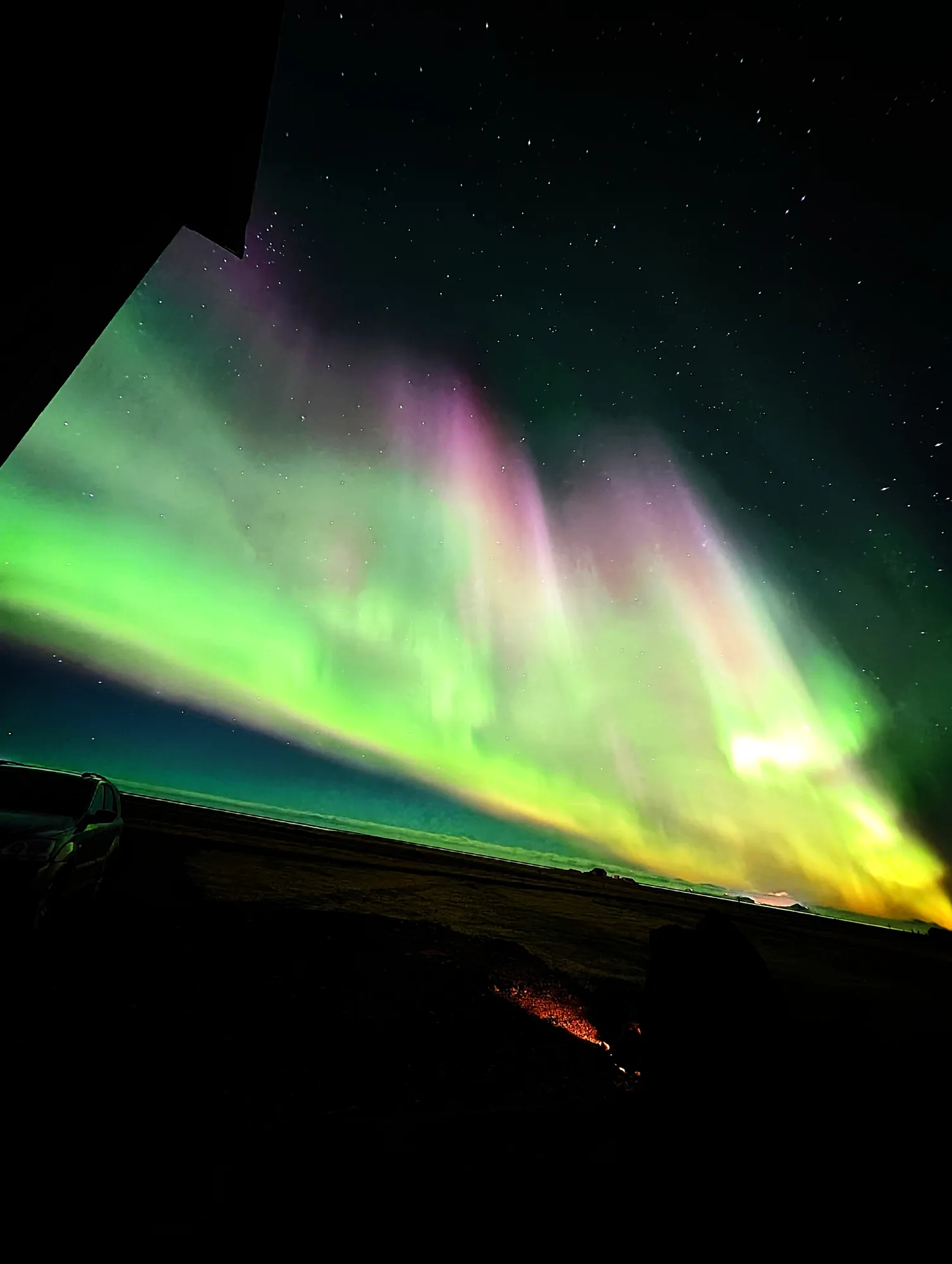
Under a glass roof you can wait indoors, warm, with the camera already on the tripod by the door. When something starts, you are outside in ninety seconds. Over a week that difference is the whole trip.
Shooting through the glass is a compromise
You can absolutely shoot through it, and people get lovely frames that way. But be honest with yourself about two things.
Reflections. Every light inside the cabin will bounce off the glass and into your frame. Kill everything. Phone face down, screen brightness at minimum, no standby LEDs. A dark coat or towel draped over your head and the back of the camera helps more than you would think.
Condensation and rain marks. Glass outdoors in an Icelandic winter collects things. On a clear cold night it is usually fine. After a wet day it is not.
Our honest advice: shoot through the roof for the atmospheric shot of the cabin interior with green above, and step outside for the frames you actually want to print.
The settings we start from
Every night is different, so treat these as a starting point, not a recipe.
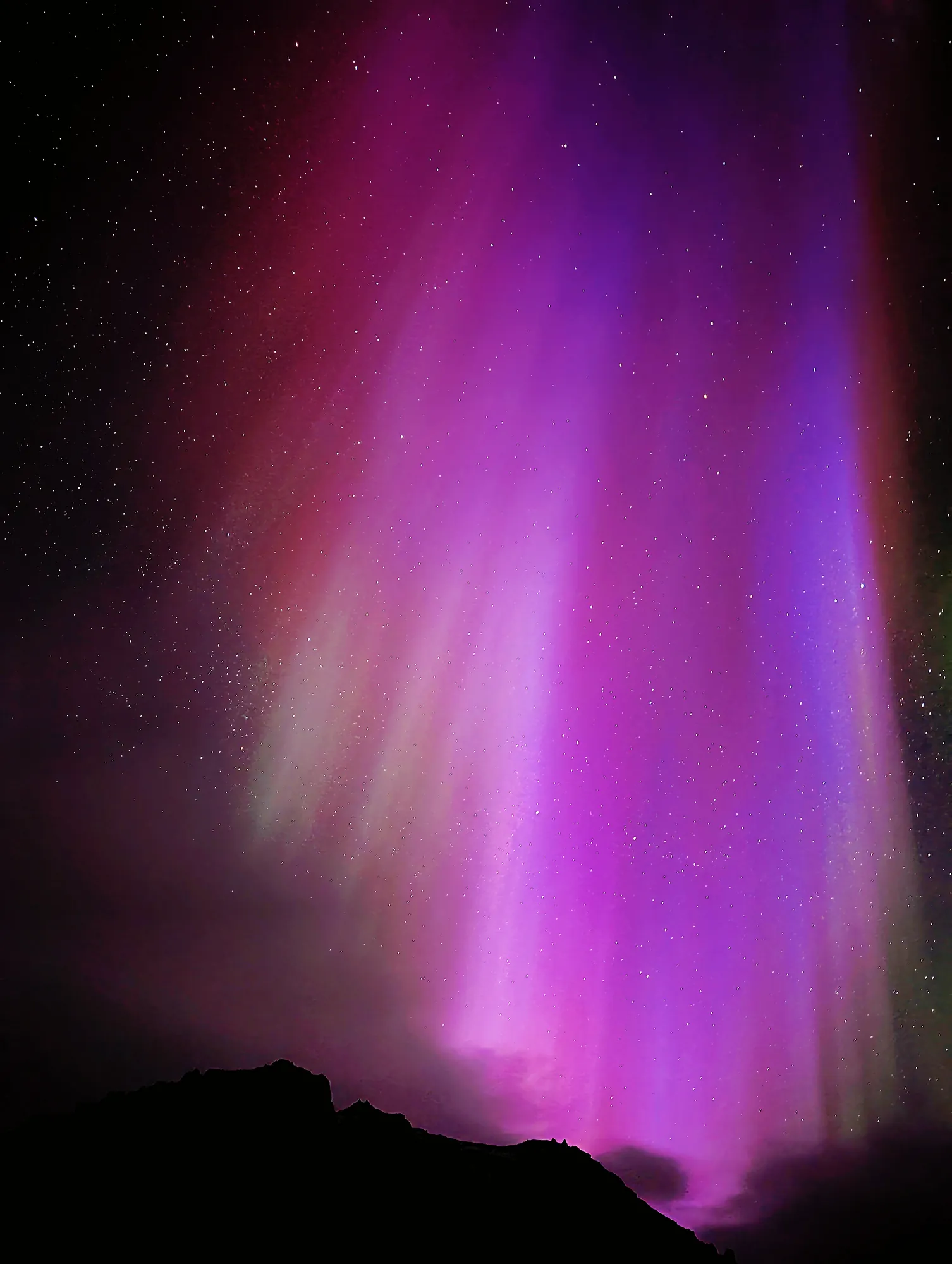
Lens. The widest and fastest you own. Something in the 14–24mm range at f/2.8 or faster. If your fastest lens is f/4, it still works, you just push the ISO.
Mode. Full manual. Autofocus will hunt in the dark and fail.
Focus. Switch to manual focus, point at the brightest star, magnify on the live view screen as far as it goes, and turn the ring until the star is the smallest possible point. Then tape the focus ring down. It will drift, usually at the worst moment.
Shutter. Two to four seconds for a fast, structured display with visible rays. Eight to fifteen seconds for a faint, slow arc. The mistake almost everyone makes on their first night is leaving the shutter open too long on an active aurora, which turns beautiful vertical curtains into a flat green smear.
ISO. Start at 1600 and go up. Modern cameras handle 3200 and 6400 far better than people assume, and a slightly noisy sharp frame beats a clean blurry one every time.
Format. Raw. The colour balance on aurora frames almost always needs fixing afterwards.
Practical things. Bring more batteries than you think, and keep the spares in an inside pocket against your body. Cold kills them fast. A head torch with a red mode saves your night vision and stops you ruining everyone else’s frames.
Phones are better than they used to be. Recent phones in night mode will genuinely capture a decent display, especially propped steady against something. They will not give you the detail a camera on a tripod will, but do not let anyone tell you not to bother.
Reading the forecast without the hype
We have a live aurora forecast on the site with the Kp index, cloud cover and a three-day outlook. Here is how we actually read it.
Kp is not the number people think it is
Kp measures geomagnetic disturbance on a 0 to 9 scale. Because Iceland sits at high latitude, roughly 63 to 66°N, we sit close to the auroral oval already, so we need far less than most places. A moderate Kp 2 or 3 is enough for a clear green band from somewhere genuinely dark, and Kp 4 to 5 can produce vivid colour and overhead structure.
People have seen displays at Kp 0. People have also stood under a Kp 6 and seen nothing but cloud.
Cloud is the variable that decides your trip
This is the one nobody wants to hear. In coastal South Iceland, cloud cover will make or break far more nights than solar activity will. The Icelandic Met Office publishes a combined aurora and cloud cover forecast that shows both on the same map, which is exactly the right way to read it.
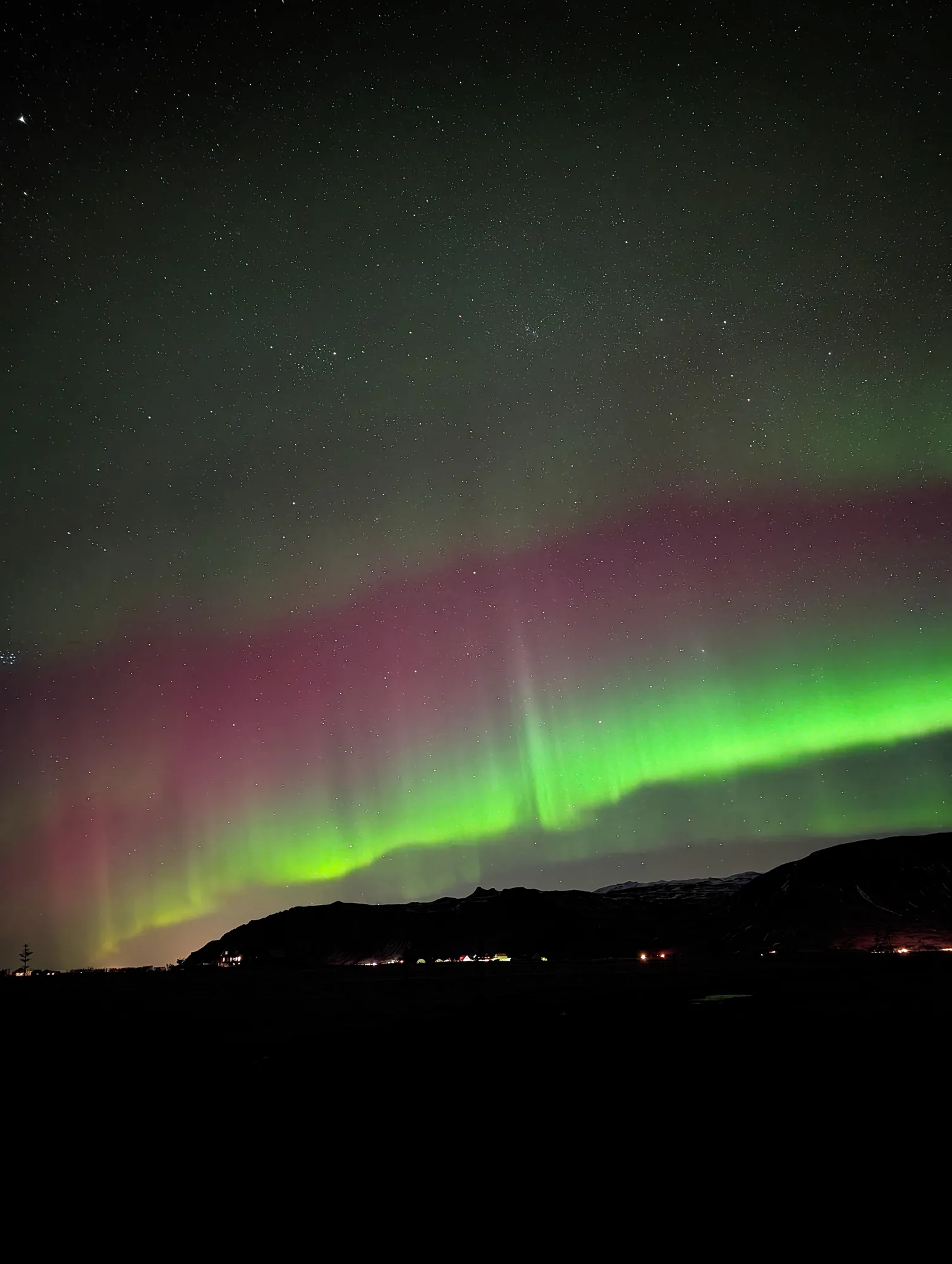
One detail worth knowing that the Met Office states plainly on that page: the sunset, darkness and moonrise times shown are calculated for Reykjavík. We are well over a hundred kilometres east of there, so shift your expectations accordingly.
Season and timing
The season runs roughly from late August to mid-April, because what you need first is darkness. The most active window on any given night tends to fall between about 21:00 and 01:00, though displays can start as soon as it is properly dark and run until dawn.
The equinox question, honestly
You will read that aurora activity peaks around the equinoxes in March and September. This is real — the pattern has been in the geomagnetic record since the 1850s, and Russell and McPherron explained it geometrically in 1973.
But we will not oversell it. The mechanism is still argued about: Cliver and colleagues proposed in 2000 that most of the seasonal signal comes from reduced coupling at the solstices rather than enhanced activity at the equinoxes. Either way you get the same practical advice — late September and late March are good bets — but it is a statistical tilt, not a guarantee.
Is 2026–27 still a good season?
Yes, with a caveat we would rather state than hide.
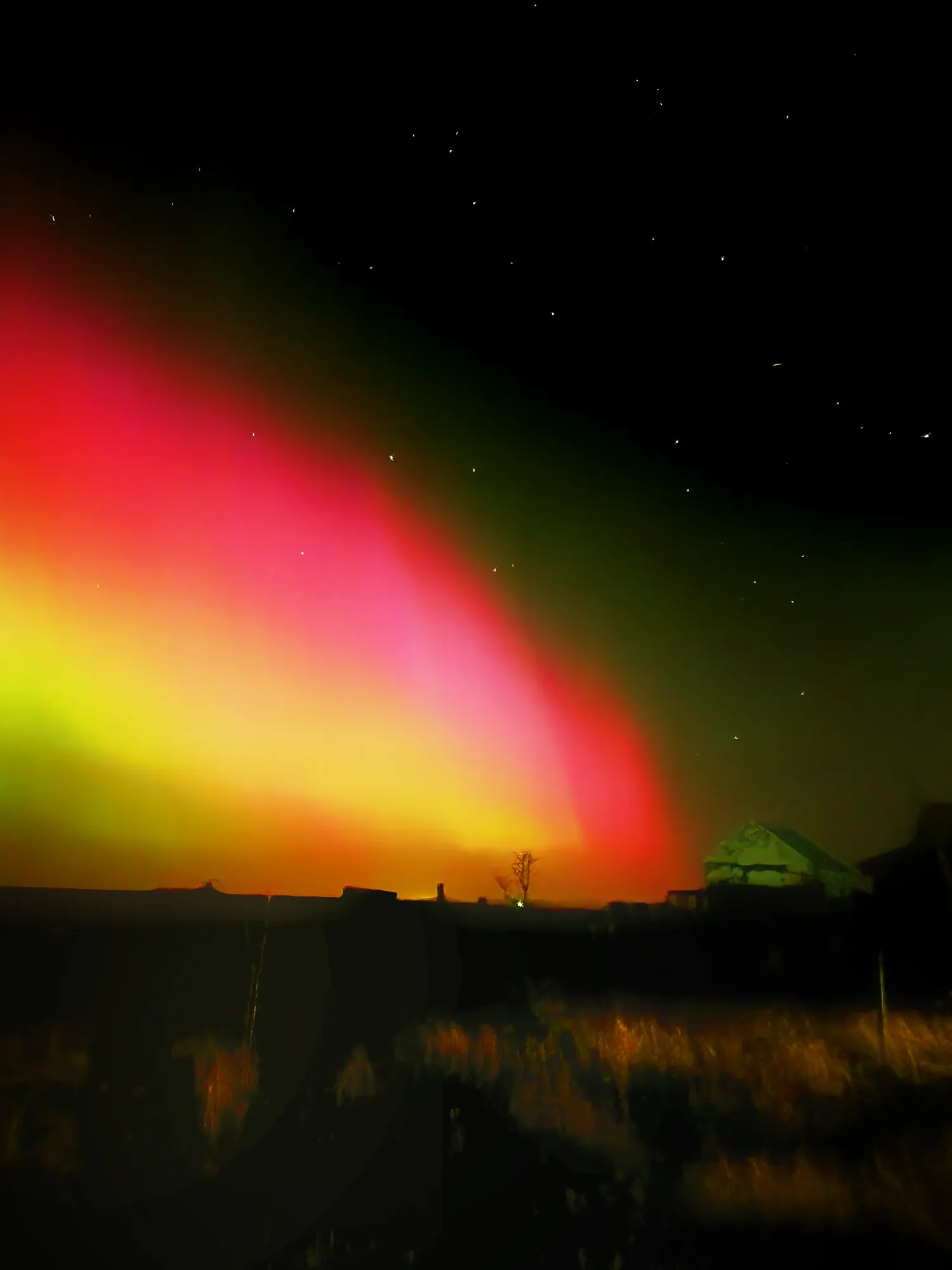
NASA and NOAA announced that Solar Cycle 25 reached its maximum in October 2024, with a smoothed sunspot number around 161, one of the stronger peaks in decades. We are now in the declining phase, which means fewer sunspots and fewer coronal mass ejections than in 2024.
That is not the bad news it sounds like. Sunspot numbers taper over years rather than dropping off, and historically some of the most intense geomagnetic storms have arrived one to three years after solar maximum, not at it. And at our latitude you were never dependent on a headline storm in the first place.
Compose for the foreground
The single biggest improvement most people make is remembering that a photograph of green sky alone is boring after the third one.
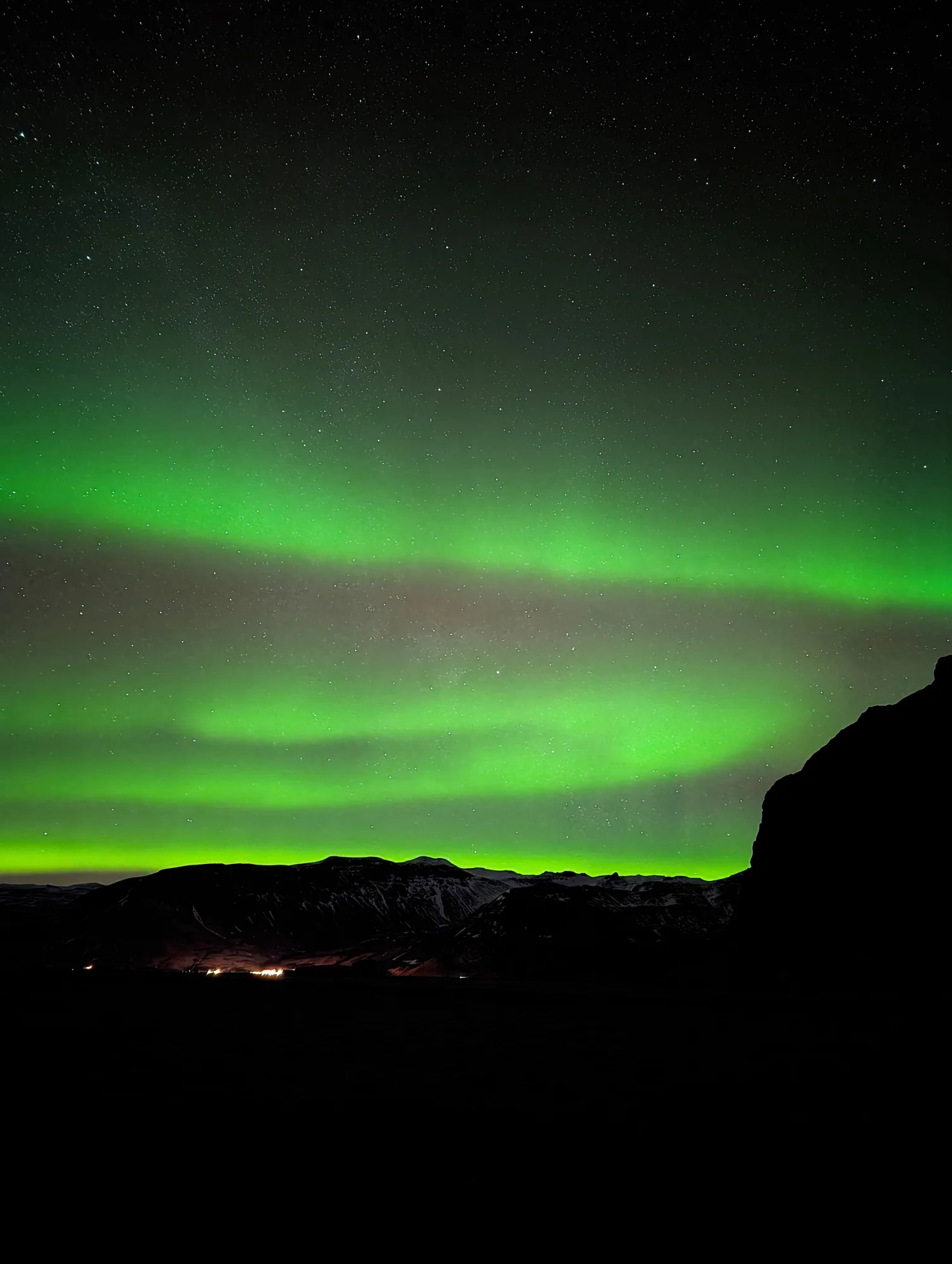
You have Eyjafjallajökull. You have the farm buildings, the horses, the cabin’s own lit windows, and the fence lines running out into the dark. Put something in the bottom third of the frame. It gives scale, it gives place, and it makes the picture yours rather than one that could have been taken anywhere in the Arctic.
If you want to shoot the waterfalls under the aurora, both Seljalandsfoss and Skógafoss are about ten minutes away, and they are very different problems: one you can walk behind, one is a wall of spray that will coat your front element in seconds. Bring cloths.
Which cabin, and what else you get
All four of our cabins have a private outdoor hot tub — private, not shared. Aurora Glass Cabin I and II have the glass roofs and also have a private sauna, and sleep two. Aurora Cabin and Seljalandsfoss Cabin each sleep up to four, and Seljalandsfoss Cabin is our family cabin.
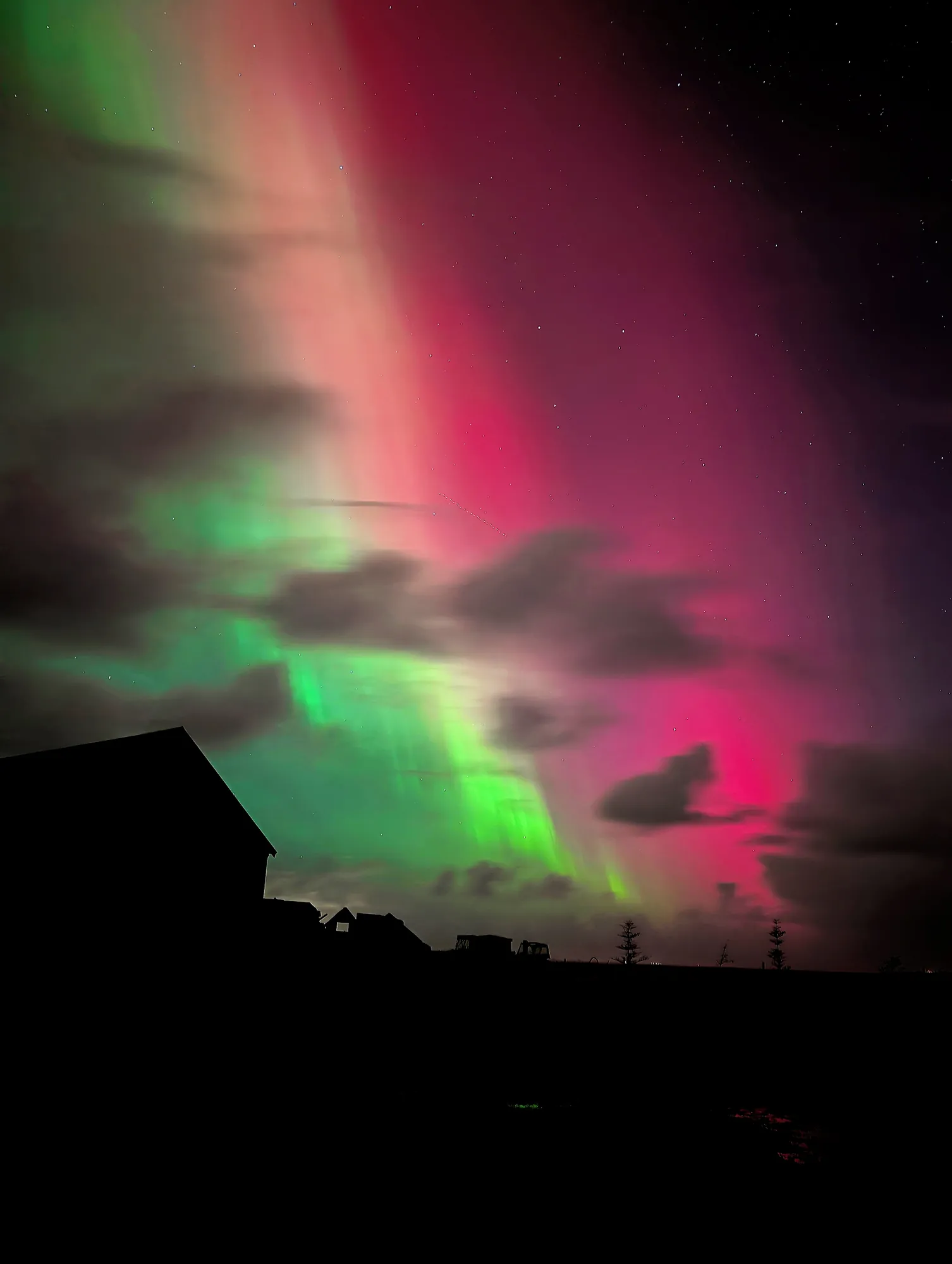
Sitting in a hot tub at minus five with the sky doing something ridiculous overhead is, for what it is worth, the thing most guests mention afterwards rather than the photographs.
There is a kitchen, free WiFi, private parking, and self check-in from 16:00, which matters in winter when you arrive after dark. We are on the farm if you need us. No pets, and non-smoking.
You can see all four on our cabins page, and there is more on conditions and timing in our northern lights guide and the wider travel guide. When you are ready, check dates here.
One last honest thing
Nobody can promise you the aurora. Anyone who does is selling something.
What we can tell you is that darkness, a clear northern horizon and time are the three things that decide it, we have the first two, and the third is the reason to stay more than one night. In four nights here you will usually get at least one that works. In one night, you are gambling.
Bring warm layers, bring spare batteries, and set an alarm for two in the morning. We have never regretted getting up.
Sources
- Icelandic Meteorological Office, combined aurora and cloud cover forecast — en.vedur.is
- Icelandic Meteorological Office, background on how the aurora forecast is produced — en.vedur.is
- Space.com, on Solar Cycle 25’s declining phase and 2026 aurora prospects — space.com
- NOAA Space Weather Prediction Center, Solar Cycle Progression — spaceweather.gov
- Russell–McPherron effect, overview — en.wikipedia.org
- Cliver, Kamide & Ling (2000), “Mountains versus valleys: Semiannual variation of geomagnetic activity”, Journal of Geophysical Research — agupubs.onlinelibrary.wiley.com
- Space.com, on the equinox boost to auroral activity — space.com